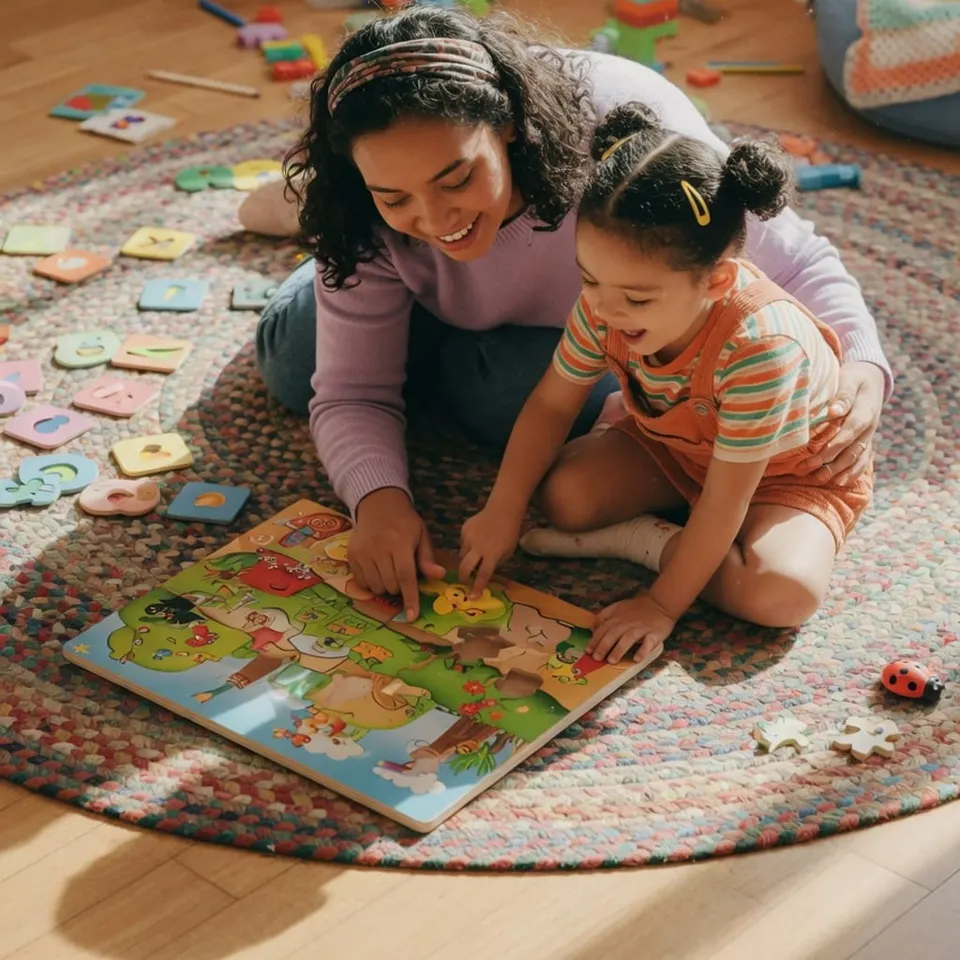
In-home ABA means a trained therapist works with your child in the rooms where their day already happens, on the skills that room demands. A BCBA writes and owns the treatment plan; a behavior technician delivers most of the direct hours and is supervised against it. Sessions usually run 2 to 4 hours, several days a week, and the total is set by an assessment rather than by a package.
What an in-home session actually involves
A behavior technician arrives at an agreed time, usually for a block of two to four hours. They bring a tablet for data and, depending on the goals, a small bag of materials. Everything else is already in your house, which is the entire point.
The work is built around the routines that are happening anyway. If the goal is asking for help, the teaching happens at the snack cupboard your child cannot reach. If the goal is tolerating transitions, it happens at the actual moment the tablet goes away before dinner. If the goal is dressing, it happens at the real bedroom drawer, in the real morning. Skills taught in the place they are needed do not have to be transferred anywhere afterwards.
Sessions are not silent drill work. Most of the hour looks like play, because play is where a young child will tolerate hundreds of learning opportunities without noticing that is what they are. The technician is recording as they go, so a session that looks relaxed is still producing the data the BCBA reads that week.
Your role is smaller than most parents expect and more important than they expect. You are not required to run the session. You are asked to be reachable, to be shown what worked so the same response happens on Saturday when nobody is there, and to say plainly when a goal does not matter to your family. A plan your household will not actually follow is a plan that fails quietly.
In-home or a center, and how to tell which you need
Providers who only offer one of these will tell you it is better. Both are legitimate, and the honest answer depends on the child.
| Consideration | In-home | Center based |
|---|---|---|
| Where skills are learned | In the setting where they are needed, so no transfer step | In a therapy room, then generalized to home as a separate goal |
| Daily peer contact | Siblings and neighbors, incidental | Built in, with other children present all day |
| Family time cost | No commute, sessions fit around school and naps | Two trips a day, and a schedule the center sets |
| Hard behavior at home | Treated where it happens, at the time it happens | Reported after the fact and reconstructed |
| Household demands | Needs a usable space and a family willing to have a therapist in the house | Needs none of your space |
| Distraction | Real life, which is the target and also the difficulty | Controlled, which helps some children learn faster at first |
A center is the better first choice for a child who needs a structured environment and daily peer practice, or for a family with no room and no adult available during the day. In-home is the better first choice when the presenting problems are domestic, which they usually are: mealtimes, bedtime, transitions, siblings, leaving the house. Many children do well with one and later move to the other, and that is a normal outcome rather than a failure.
Where in New Jersey we work
New Jersey is about 170 miles top to bottom and the density of providers is nothing like even. Families in Bergen and Essex have real choice. Families in Salem, Cumberland and Warren often call a list of providers and get the same answer about travel radius from all of them.
We staff by county rather than by a single office radius, so the question we can answer on the first call is a concrete one: whether there is a technician near you now, and if not, what the honest timeline is. Pick your county for local detail.
If your town sits on a county line, call anyway. The border matters to the map and not to the scheduling.
Who is on the team, and who is accountable
Two roles do the work and it is worth knowing which is which, because the difference is where quality lives.
A BCBA, a Board Certified Behavior Analyst, assesses your child, writes the treatment plan, sets each goal and the criteria for meeting it, and changes the plan when the data says to. The plan is theirs and so is the responsibility for it.
A behavior technician, often an RBT, delivers most of the direct hours against that plan. Under the BACB's published requirements, an RBT must receive ongoing supervision covering at least 5 percent of the hours they spend delivering behavior-analytic services each month, and that supervision has to include direct observation with the client present.
So when you are comparing providers, the useful questions are not about philosophy. Ask how many hours a month your BCBA will spend observing sessions, how often the plan is formally reviewed, who covers a session when your technician is sick, and what happens if the fit between your child and that technician is wrong. The answers are specific at a good provider and vague at a stretched one.
How the weekly hours are decided
Nobody should quote you an hours figure before assessing your child. The published clinical standards describe two broad models, and the assessment decides which one fits.
Focused programs target a limited set of goals, commonly a specific behavior of concern or a communication deficit, and typically run in the range of 10 to 25 hours a week. Comprehensive programs address multiple developmental domains at once and typically run higher, in the region of 26 to 40 hours a week, and are more often indicated for younger children with broad delays.
Those bands come from the practice standards that funders review against, not from a menu. Two things follow. First, an hours recommendation should be traceable to findings in the assessment, and you are entitled to ask which finding drives it. Second, the number is expected to change: hours usually step down as goals are met, and a program that never reduces intensity is not describing progress.
Your plan is also constrained by what your insurer authorizes, which is a separate conversation. We cover how that works, plan by plan, on our ABA insurance coverage page.
Starting, and the two things that usually slow families down
The sequence is short. A diagnostic evaluation establishes autism. We verify your benefit and tell you what it covers before you commit to anything. A BCBA completes an assessment in your home. The insurer authorizes a plan. Therapy starts.
Two steps are where months disappear, and neither is the therapy.
The evaluation. If your child does not yet have a diagnosis, this is usually the longest wait in the whole process, and it sits with developmental pediatricians and psychologists rather than with us. Start it the week you first wonder, not after you have finished researching providers. If you are already on a waiting list for one, ask to be placed on several.
Prior authorization. Most plans require approval before ABA begins, based on the assessment and treatment plan. Turnaround commonly runs one to three weeks once a complete packet is submitted, and the usual cause of delay is an incomplete packet rather than a refusal. This is our job to chase, and you should expect to be told where it stands without having to ask.
New Jersey has required state-regulated health plans to cover autism services since 2009, and NJ FamilyCare covers medically necessary ABA for members under 21. If you want the detail before you call, it is on the coverage page. If you would rather just get moving, start here and we will verify the benefit for you at no cost.
How progress is measured in a home program
The honest test of a program is whether you can see it working without being told that it is.
Every session produces data against named goals, and those goals have written criteria for being met. Your BCBA graphs them, and you should be able to look at a graph and understand it. Flat lines for weeks are not a scandal, they are information, and the correct response is a plan change rather than more of the same.
Two measures matter more than the rest in a home program. The first is generalization: does the skill hold when a different person asks, in a different room, at a different time of day. A skill that only appears with one technician on the living room floor is not finished. The second is whether the goals still describe your family's actual problems. Goals written in March can be irrelevant by September, and reassessment, normally every six months for authorization purposes, is the moment to say so.
You are entitled to see progress in plain language at any point. A provider who cannot explain in a sentence what changed this month, and what they are trying next, is not measuring carefully.
Common questions about in-home ABA in New Jersey
Does my home need to be set up a certain way?
No. What helps is a predictable spot with room for an adult and a child to sit and play, and somewhere to keep a few materials between visits. A kitchen table is enough. Your BCBA will point out anything worth changing at the assessment, and it is usually smaller than families fear.
Do I have to be home during sessions?
An adult who is responsible for the child needs to be in the home. You are not expected to sit in on every hour, and most parents do not. Plan on being present for part of the session often enough to be shown what is working, because the response only holds if it is the same when we are not there.
How many hours a week should we expect?
It depends on the assessment. Published standards describe focused programs in the range of 10 to 25 hours a week and comprehensive programs higher, roughly 26 to 40. Your BCBA should be able to tell you which findings drive the recommendation, and the figure is expected to fall as goals are met.
Can sessions happen somewhere other than our house?
Often, and sometimes they should. If the difficult moments are at the playground, the supermarket or a relative's house, that is where the teaching belongs. Community sessions are planned deliberately against a goal rather than added for variety, and school-based hours depend on the district.
We are in a rural part of the state. Can you actually come?
Tell us your town and we will give you a straight answer rather than a maybe. Coverage in Salem, Cumberland, Warren and Sussex depends on whether a technician is currently placed near you. If we cannot staff you properly, we will say so on the first call instead of adding you to a list and going quiet.
Will our other children be part of it?
Usually yes, in the sense that siblings are the most available peers your child has. Sibling goals are written into plenty of plans, from turn taking to simply being in the same room during a preferred activity. It is deliberate, and it is discussed with you first.