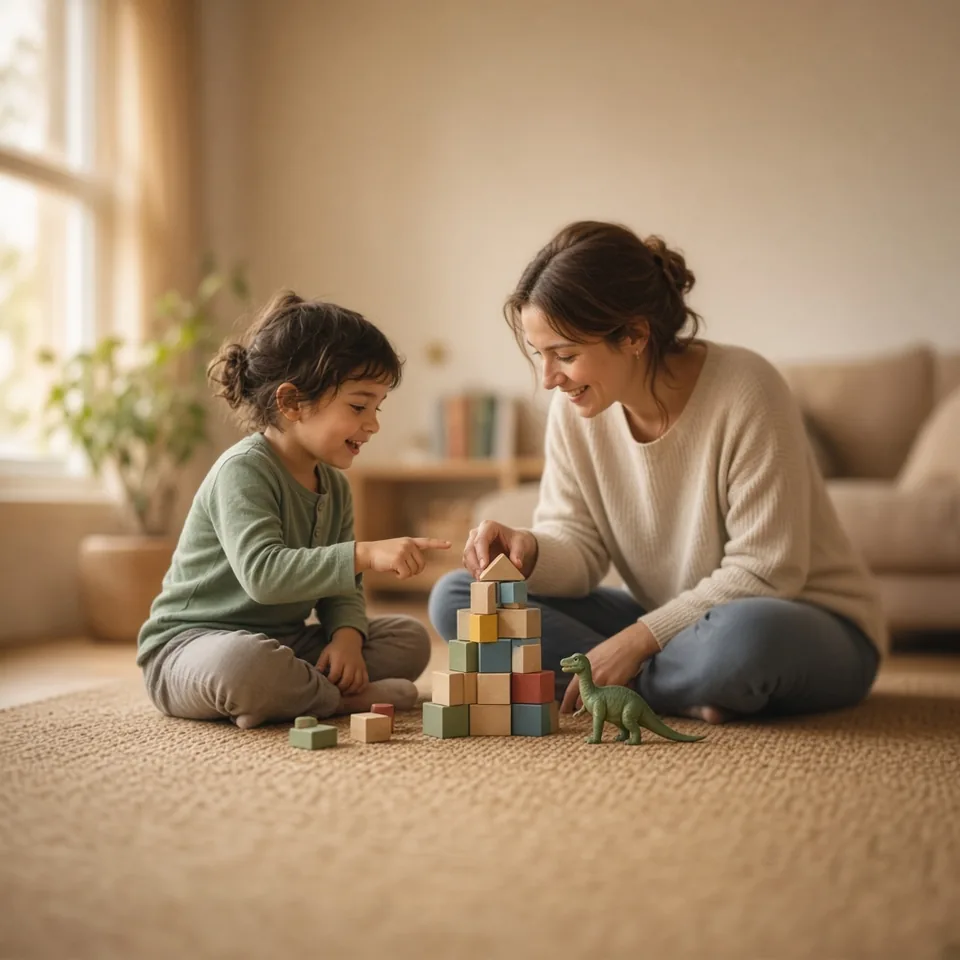
ABA therapy uses naturalistic teaching methods like modeling, prompting, and reinforcement to help children with autism learn social communication beyond just words. It builds skills such as eye contact, turn-taking, understanding gestures, and initiating interactions, all within real-life settings like home and community. New Jersey families can access these services through private insurance, NJ Medicaid, and early intervention programs.
For many parents of children with autism, the word communication often brings spoken language to mind. But truly connecting with others involves so much more than words. From a shared glance to a wave goodbye, the subtle dance of social communication shapes every interaction. Applied Behavior Analysis (ABA) therapy is uniquely equipped to teach these skills systematically and compassionately, helping New Jersey children build meaningful relationships beyond verbal expression.
What Is Social Communication Beyond Words?
Social communication refers to how we use language, gestures, facial expressions, and context to interact with others. It includes both verbal and nonverbal behaviors that allow us to share ideas, express feelings, and build connections. For children with autism, challenges in social communication often extend beyond speech delays, they may find it difficult to read body language, understand tone of voice, take turns in conversation, or initiate play. ABA therapy breaks down these complex skills into teachable steps, focusing on the pragmatic use of communication in everyday situations.
In New Jersey, early intervention through programs like NJEIS (New Jersey Early Intervention System) can identify these needs as early as age three. County special-services school districts also offer support, but intensive in-home ABA can provide the consistent, one-on-one practice many children require to master social nuances.
How ABA Targets Nonverbal Communication
Nonverbal communication-eye contact, gestures, proximity, facial expressions, often forms the foundation of social interaction. ABA therapists use evidence-based strategies to teach these skills in natural environments.
Modeling and Imitation
Children learn by watching others. A BCBA or therapist might model a gesture, such as pointing to a desired toy, while pairing it with a verbal label. The child is then prompted to imitate the gesture. Over time, the child learns to use pointing spontaneously to request or share interest. This technique is especially powerful during Natural Environment Teaching (NET), where learning happens during play, snack time, or other daily routines at home.
Reinforcement of Eye Contact
For many children with autism, making eye contact can be uncomfortable or confusing. ABA breaks this into small steps. The therapist might first reinforce brief eye glances, gradually shaping longer duration. The key is pairing eye contact with positive experiences, so the child associates looking at another person with something enjoyable, like receiving a favorite toy or a warm smile. Over time, eye contact becomes a natural part of interaction.
Teaching Turn-Taking and Joint Attention
Joint attention-sharing awareness of an object or event with another person, is a critical milestone. In an in-home session, a therapist might roll a ball back and forth, pausing and using nonverbal cues to signal the child's turn. The therapist may also use exaggerated facial expressions and vocal tones to highlight moments of shared excitement. Continuous data collection ensures the child is progressing toward spontaneous joint attention in everyday settings.
Building Conversation Skills Through Natural Environment Teaching
While words are important, conversation involves a rhythm of listening, responding, and adjusting based on feedback. ABA teaches these skills through structured yet flexible methods.
Initiating and Maintaining Topics
A child might learn to start a conversation by saying hello or commenting on a nearby object. The therapist then models how to ask a follow-up question or add a related statement. Role-playing common scenarios, like ordering at a snack table or greeting a friend-helps the child practice in a safe, low-pressure environment. As skills improve, the therapist gradually fades prompts, encouraging independence.
Understanding Nonverbal Cues in Conversation
Reading a listener's facial expression or body language is essential for social success. ABA uses video modeling, social stories, and direct feedback to teach children to recognize cues like a frown indicating confusion or a nod showing agreement. In New Jersey, where diverse communities mean children may encounter a range of cultural expressions, therapists adapt examples to be relevant and respectful.
Flexible Thinking and Perspective-Taking
Advanced social communication requires the ability to shift topics, repair misunderstandings, or adapt language for different listeners. ABA therapists gradually introduce these challenges. For instance, a child might practice telling the same story to a younger sibling (using simple words) and to a parent (adding more detail). Reinforcement is provided for flexible language use, not just for saying the right words.
Why In-Home ABA Is Ideal for Social Communication Goals
Social skills are best learned where they are used most: at home, in the backyard, or on the neighborhood playground. In-home ABA therapy ensures that teaching happens in the child's natural environment, with familiar people and materials. This setting allows for immediate practice of skills like greeting a family member, sharing a toy with a sibling, or asking for help from a parent. Skills learned in a clinic may not automatically transfer to home; in-home therapy eliminates that gap.
Liftoff ABA provides exclusively in-home ABA across New Jersey, with no waitlists so families can begin services within weeks. Each child is paired with a dedicated therapist who works under the supervision of a BCBA. The BCBA designs a personalized treatment plan that targets the child's specific social communication needs, whether that involves learning to request items nonverbally or engaging in back-and-forth play. Parents are coached on how to reinforce these skills between sessions, creating a consistent learning environment.
Navigating Insurance and Funding in New Jersey
Access to ABA therapy is supported by New Jersey's strong autism insurance mandate and public programs. Most major private insurance plans cover ABA for autism, including social communication goals. For families without private insurance, NJ FamilyCare (New Jersey's Medicaid program) covers ABA therapy through contracted providers. The New Jersey Early Intervention System (NJEIS) can fund ABA for children under three, while PerformCare coordinates behavioral health services for youth. Liftoff ABA accepts NJ FamilyCare and most major insurance plans, and offers free benefits verification to help families understand their coverage before starting therapy.
Additionally, many county special-services school districts partner with ABA providers to ensure that social communication goals from a child's IEP are addressed consistently. In-home ABA can complement school-based services, providing additional hours of intensive practice in a familiar setting.
Measuring Progress in Social Communication
Progress in social communication is measured through ongoing data collection and analysis. Therapists track each goal, such as frequency of spontaneous eye contact, number of conversational turn-takes, or use of gestures, during every session. Graphs and reports are shared with the BCBA and family regularly. This data-driven approach ensures that teaching strategies are effective and adjusted as the child grows. Celebrating small wins, like a child independently waving goodbye, is part of the process.
Importantly, ABA therapists use person-first and neurodiversity-affirming language, respecting that some children may continue to communicate in ways that work best for them, such as via AAC devices or sign language. The goal is not to force neurotypical behavior but to expand the child's skills for building authentic connections.
If you're a New Jersey parent exploring how ABA can help your child with social communication, consider the benefits of in-home therapy with a dedicated, BCBA-led team. Liftoff ABA is ready to support your family with compassionate, evidence-based care, no waitlists, just focused, individualized teaching in the environment where your child lives and grows.
- ABA therapy explicitly teaches nonverbal social cues like eye contact, gestures, and body language.
- Techniques such as Natural Environment Teaching (NET) embed learning into daily routines at home.
- BCBA-led plans are individualized, ensuring each child works on their unique social communication goals.
- In-home therapy in New Jersey allows skills to generalize naturally to real-world settings.
- NJ families can use insurance, NJ FamilyCare, NJEIS, or PerformCare to fund ABA services.
- Liftoff ABA offers immediate enrollment with no waitlists for in-home therapy across New Jersey.
Not sure what your plan covers?
Liftoff ABA verifies your New Jersey insurance benefits for free, no obligation, usually the same day.
Check my coverageFrequently asked questions
What is social communication beyond words?
How does ABA therapy teach nonverbal communication?
Is ABA therapy for social communication covered by New Jersey insurance?
What is Natural Environment Teaching in ABA?
Can in-home ABA help if my child already receives school-based services?
Start ABA therapy in New Jersey, no waitlist
We'll verify your insurance for free and map out your child's next steps. Most families start within weeks.
Apply for ABA